One of my greatest talents is confusing Wrestling Observer subscribers. I’m in an invite-only online space with many WON/R readers and listeners that formed because the quality of conversation on The Board~! and the podcasts have been steadily declining for years. I consider these men—thoughtful, considerate, kind men—to be my friends. Most are AEW viewers, and I can’t recall a week when I didn’t say something to make them roll their eyes. Sometimes it’s my criticism of Toni Storm’s promos; other times, it’s my steadfast insistence that Konosuke Takeshita might be the worst wrestler alive. But without fail, every seven to ten days, I say something that makes these friends question my sanity.
This isn’t a gimmick or anything: while I still watch AEW fairly regularly and find myself enjoying it more often than not. But the thing that keeps me from loving the company the way I did in 2021-22 is the relentless, almost pathological commitment to maximalism that seems to seep into every corner of the product. It’s not just the matches, though those are often padded out to the point where I’m checking the clock and wondering if I’d be better off DMing Chris for Avisman match recommendations; it’s the promos that stretch on long after they’ve run out of anything interesting to say and the pay-per-views that exceed the length of two viewings of One Battle After Another. This is not solely an AEW problem but one that plagues most large promotions: WWE, NJPW, Stardom, and occasionally even CMLL will overindulge themselves in these or other tendencies. We’re living in an era where, on paper, wrestling has never been more accessible or abundant, yet promotions tend to lean into a “more is better” approach that often makes their end product feel dense, poorly paced, and overwhelming.
It would be one thing if this overindulgent approach were limited to the major promotions of the world, but we’d be lying to ourselves if we pretended this didn’t trickle down to the indies. It is logical that aspiring performers will chase the trends that make the most famous wrestlers popular, which means that it’s impossible to watch a single indie show without at least one match featuring a litany of hypercoreographed athletic spots or poorly-convinced 2.99995 counts. Bookers tend to fall into this trap as well—even for all the well-founded praise, the recently-shuttered DPW did have a reputation for being a workrate-heavy promotion that occasionally left its shows feeling a little one-noted. And that’s to say nothing of the one company that, due to its mult-year contract with a streaming company that may or may not be defrauding its shareholders after going public in July 2024, ran approximately twenty-two billion shows in 2024.
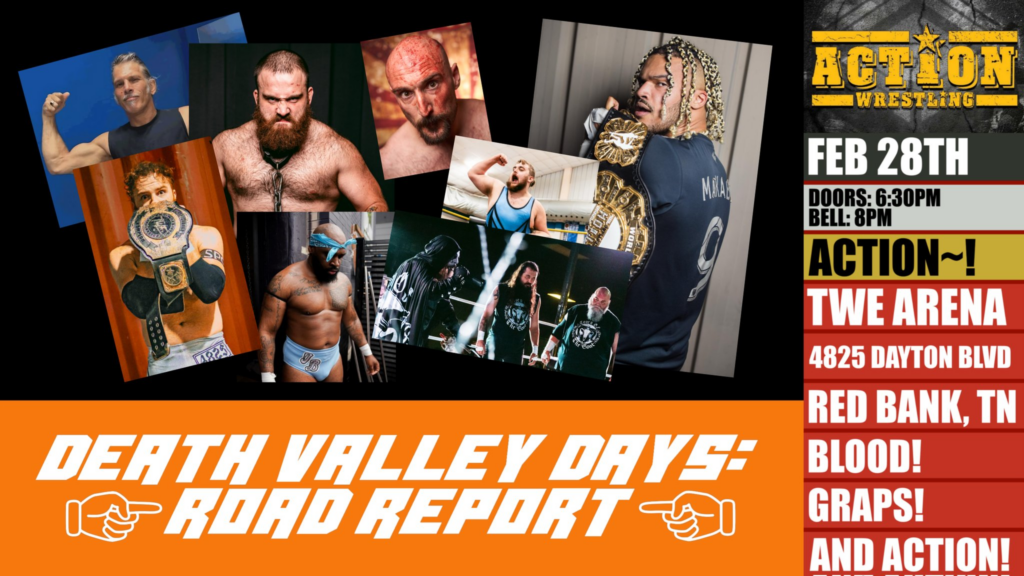
It’s against this backdrop of industry-wide maximalism that Action Wrestling’s Death Valley Days: Road Report show from the TWE Arena on February 28th, 2026 stands out. I’m not the Violent Person best equipped to give you the historical background on this show, but I do have the broad strokes: “Road Report” is a reference to a review format on DVDVR where staff writers would have free-flowing conversations about a wrestling event show they all attended together (here’s an example from a 2008 Ring Of Honor show). This format was conceived by the late Dean Rasmussen, who Phil, Eric, Matt G, and J.R. have book shows that lovingly paid tribute to the beloved fan/reviewer/tape trader with three excellent DEAN~! shows, two co-produced with AEW/ROH and one previously co-produced by Action.
For full transparency, I came into this match with limited knowledge of most of the workers involved. But what I’ve enjoyed most about this team’s previous shows is the attention to detail they pay to booking decisions and agenting matches. It is rare these days to turn on a wrestling show and see such a wide variety of styles, performers, and outcomes that have made the DEAN shows appointment watching. There are some workers I was familiar with (Slim J, TANK, Matt Mako) and others I didn’t know who either had incredible names (Oldman Youngboy, Angus Legstrong) or incredibly fascinating hairlines (Tim Bosby). But the large appeal here for me was the main event: Mad Dog Conelly vs. SLADE, the stiffest, most demented two wrestlers in the country who are not named Matt Tremont.
But there is the furthest thing from a one-man card I’ve seen in a while: this is a show that was carefully booked to be a sum of its own parts. The opening match—Darian Bengston vs. Ryan Mooney—was clearly meant to be an opening match, allowing Mooney and Bengston to prioritize limb work and reversal sequences at a steady, controlled pace. Angus Legstrong vs. Oldman Youngboy (truly two of the most delightfully ridiculous but fitting gimmicks) had a sub-5-minute technical match that would allude to work we’d see in the semi-man (I’m hoping this gets serious consideration for Corvo’s 10 under 10 next year). Isaiah Broner vs. Jake Shepherd had a fucking hoss fight, with both Broner and Shepherd pulverizing each other with stiff forearms and chops around the apron and ending with Broner throwing out one of the sickest fucking F-5’s I’ve ever fucking seen. Kasey Owens and Adrian Alanis put on a charming straight wrestling match, with Alanis being the type of heel who at first impression had me thinking, “I sure hope this man dies in a fire” (I say this affectionately).
Getting four matches in under 45 minutes feels like an achievement at this point; that each one of them had a clear booking philosophy distinct from the other matches on the card is borderline miraculous. Even if there wasn’t something for you in these opening matches, it at least becomes clear that the show was building to an emotional climax. And none of these matches overstay their welcome.
The last 75 minutes stand out for different reasons, so let me break them down.
Billed as “Southeast’s future versus Southeast’s past,” Tim Bosby vs. Slim J was the match that sold me on watching this show live, largely because Slim was a highlight of AEW Dark for me and I greatly appreciate the way he’s been booked on the other DEAN~! shows. He works babyface in the match and is perfectly suited for that role against Bosby: it allows Bosby to use his size and strength to his advantage against a much smaller opponent. It clocks in as the longest match on the show at 12:51 minutes, but Slim J’s selling and Bosby’s restraint are purposeful: they smartly let spots breathe and intentionally build tension on a show that had been moving at breakneck speed until this point. Slim J might be one of the most underappreciated wrestlers in America these days and his input in this match is impeccable: he sells like crazy during Bosby’s shine spots and he never lets his high spots outweigh the control Bosby is able to gain here. It’s a standout match for Bosby, as well: he has the look and tools to be a stalwart on the indies, and his ceiling might be higher than that.
Sandwiched between two traditional Southern wrasslin’ matches, Toby Klein and Nathan Mowery offer something completely different: sheer mayhem. While I am not entirely sure what a “Coven of the Goat” rules match is, it was pretty clear where this match was headed once Klein launched a VCR at Mowery’s head before the bell was rung. It’s a short burst of a match, but it features weapons, crowd brawling, and two above-average blade jobs. While this felt a bit more tame than some other maximalist no disqualification matches (cough Hangman/MJF cough), it trades spectacle for structure, with each high spot being built with solid strikes and selling. It’s a great change of pace and palette cleanser before the semi-main and main events, each of which is a standout. Some folks argued that
The semi-main was the biggest draw for many of my friends. Shoot-style wrestling (and BattlARTS specifically) is a personal blind spot for me, so I went into the semi-main event with limited knowledge of Matt Mako outside of his previous DEAN~! work and even less knowledge of Karl Greco-Malenko. That said, I didn’t need much context to appreciate the Muay Thai strikes that started the match and the technical wizardry on display throughout the rest of it. The striking from both competitors is measured, and the mat work is focused more on cumulative limb damage than on flashiness. There have been some criticisms that the standing 8-count and rope-break rules were underutilized here, and that does feel valid; that said, this feels like the most focused technical wrestling I’ve seen in America in years.
As for the main event: I came into this match with zero expectations, in large part because it often feels as if SLADE and Mad Dog Connelly are the type of wrestlers who are going to do something so wildly reckless that we will watch them develop CTE in real time. Even still, I could not have predicted such a violent match: the strikes here are stiff and the headbutts are not worked. But it’s all in service of a violence that builds in intensity that crescendos when Mad Dog introduces the dog collar. These were six calorie-dense minutes from two of the most demented wrestlers in the world, and they left tons of the table for a rematch. For a show that exclusively featured singles matches, all but one ending with a clean pinfall or tapout, it feels fitting that Death Valley Driver Days would end with such violent fireworks and serve as a love letter to the independent wrestling that made DVDVR such a vital resource for tape traders and wrestling fans alike.
As the recently deceased (I think) Sam DiMascio wrote in December, it feels as if wrestling fans are addicted to eulogizing the American independent wrestling scene. While I won’t deny that the advent of AEW has had a downstream effect on the health of the scene, it does feel disengenuous to lament that the indies are dead when shows such as this one exist: in spite of its proliferation and the bad habits of many, it is still possible for wrestling to surprise us.

- Death Valley Days: Road Report Is The Antidote To American Wrestling’s Maximalism Problem - March 23, 2026
- ECW: It Ain’t Aesop’s Fables! - February 2, 2026